Prince Harry’s Surprise Lviv Visit
For two days Prince Harry, the Duke of Sussex, moved through Lviv under a press blackout, put in place for security while Russia’s missile campaign against Ukraine continued. Only once he had left the country did the visit become public. When it did, the line that travelled fastest was a short one, delivered to wounded veterans who had come to hear him: “You’re going to win the war.”
The trip lasted 14 and 15 November and took Harry to the Superhumans Center, a clinic near Lviv that treats and rehabilitates injured soldiers and, increasingly, civilians. He watched Invictus Games trials, sat with patients at their bedsides, and spoke at a gathering organised around the centre’s first international war-trauma conference. It was his second visit to Ukraine this year, after a trip in April, and, by his own count, a fourth journey to the country since the full-scale invasion began.
The calendar made the story larger than a charity stop. Saturday was King Charles’s 78th birthday, marked in London while his younger son was more than a thousand miles away. That coincidence has been impossible to ignore in the days since, though the substance of the visit is what Harry came to do, and what the veterans in the room will remember.
A clinic, a sports hall, and a carefully delayed announcement
Reporting from Lviv after the blackout lifted described an enthusiastic welcome and some frankly emotional scenes. Ukraine has more than 150,000 injured war veterans. At Superhumans, Harry was shown treatments that, he suggested, have changed the direction of expertise. International specialists used to travel in to help. “Now that has flipped,” he said, with Ukrainian teams now holding hard-won knowledge about trauma injuries that the rest of the world is coming to study.
He lingered with individual patients rather than moving through on a handshake tour. One was Mykhailo Damaskin, a Ukrainian air-assault veteran so badly wounded in fighting in Kherson that he was not expected to walk again. An experimental spinal-cord stimulator, recharged every twelve hours, now lets him take steps he cannot feel in his feet. He controls them with his eyes, and has joked that he is “like a demo model of a Tesla.” His goal, he said, is the Invictus Games. He had promised his father, who was later killed, that he would represent Ukraine. “I’ll prove to every guy with spinal cord injuries that life goes on after injury.”
Harry also sat with Kostiantyn Vlasenko, who was lifted off the front line by drone last month in a rescue described as the first of its kind. He had been alone at his position for more than 200 days and had lost both feet. The duke told him he represented the spirit of Ukraine’s resilience, and later described the injured veterans he met as “role models,” promising that “the rest of the world will continue to support you.”
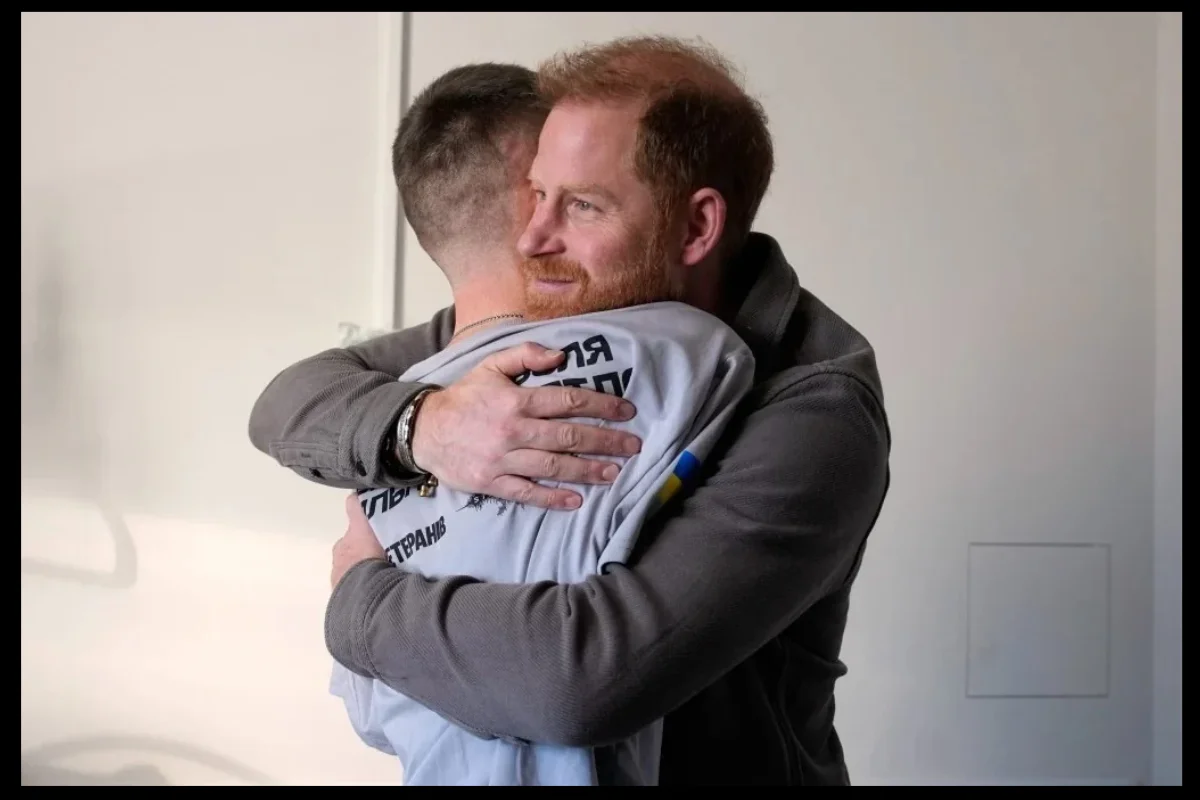
Olga Rudeva, the centre’s chief executive, has said the caseload is not only larger but more complex, with more injured civilians arriving as the front shifts and as strikes hit infrastructure. In a sports hall in the city, the visit turned from medicine to sport. Harry watched a wheelchair rugby match, was pulled into a crush of selfies and handshakes, and later tried pickleball, one of the events on the Invictus programme. He was presented with a T-shirt remembering prisoners of war still held by Russian forces, and greeted with chants of his name at an awards moment for new Invictus members.
Ivan Voinov, who has lost a leg and suffered head injuries, was among those watching. Sport, including learning to dance again with his wife, has been part of his rehabilitation and, as he described it, a way of recovering a shared life. Around 400 wounded service personnel in Ukraine have been taking part in trials for next year’s Invictus Games in Birmingham. Ukraine is preparing what would be its largest team yet, a reflection of how many athletes now compete with life-changing injuries.
What he came to say
Harry did not pretend the visit was ordinary. He has said he had “taken a risk to come here.” He also sounded like someone who has made this journey before. “Every single time I come back to Ukraine, I feel welcome, I feel warmth, I feel encouragement.” He told the room that Ukraine is living through elements of war no other country has experienced in quite this way, with drone technology reshaping both the battlefield and the protection of cities.
The most repeated sentence was the one about winning. In one account he added a second clause, about being “set up for success” when that day comes. He went further on Invictus itself, promising that “when the war is over and when Ukraine wins, we will be ready to support you in holding an Invictus Games.” That is a long-range offer, not a date, but it is a clearer institutional commitment than a passing compliment.
Rob Owen, chief executive of the Invictus Games Foundation, put the argument in plainer terms. Recovery, he said, cannot wait for the fighting to end. The scale of need is already huge, and wounded, injured and sick personnel need the chance to rebuild their lives now. Harry spoke of a “cultural shift,” from social awkwardness around visible injury to a willingness to show respect. “These people have so much to offer,” he said.
It is a royal working visit of a particular kind: a former soldier, no longer a working member of the British monarchy, using the Invictus network and a Ukrainian clinic to stand next to people whose injuries would once have ended their public lives.
The birthday he was not in London to mark
The private backdrop is harder to ignore because of the date. While Harry was in Lviv, the King was marking his birthday at home. This site has already covered how King Charles spent that 78th birthday in London. Harry was not part of it.
He, Meghan and their children moved back to Britain at the end of August, a return that briefly revived talk of a thaw. Reports since then have been cooler. It is widely held that Harry has still not had a face-to-face meeting with his father. A letter of guidance, sent at the King’s direction after the couple’s return, reminded military and government figures that the Sussexes remain private citizens, that their Royal Highness titles should not be used in official settings, and that they operate separately from the Royal Household. Relations with Prince William are also described as distant, a breach that has now lasted years.
Those facts matter as context, not as the point of the Lviv trip. Harry did not travel to western Ukraine to send a message to Clarence House. He travelled, under a news blackout, to sit with people who are learning to walk with machines in their spines, to watch a rugby match in a noisy hall, and to tell a room of veterans that the rest of the world had not looked away. The birthday only sharpened the picture of two diaries that no longer overlap.
By Monday the images were everywhere: the group hug after the match, the bedside conversation, the brief competitive turn at pickleball. The line that will last, though, is the one he chose to say out loud in a city that still listens for air-raid warnings on a phone. He told them they were going to win, and that when they do, he wants Invictus to be there with them. Whether that promise can be kept is a question for a later chapter of the war. For two days in November, in Lviv, it was the message he came to deliver.
About the Author