
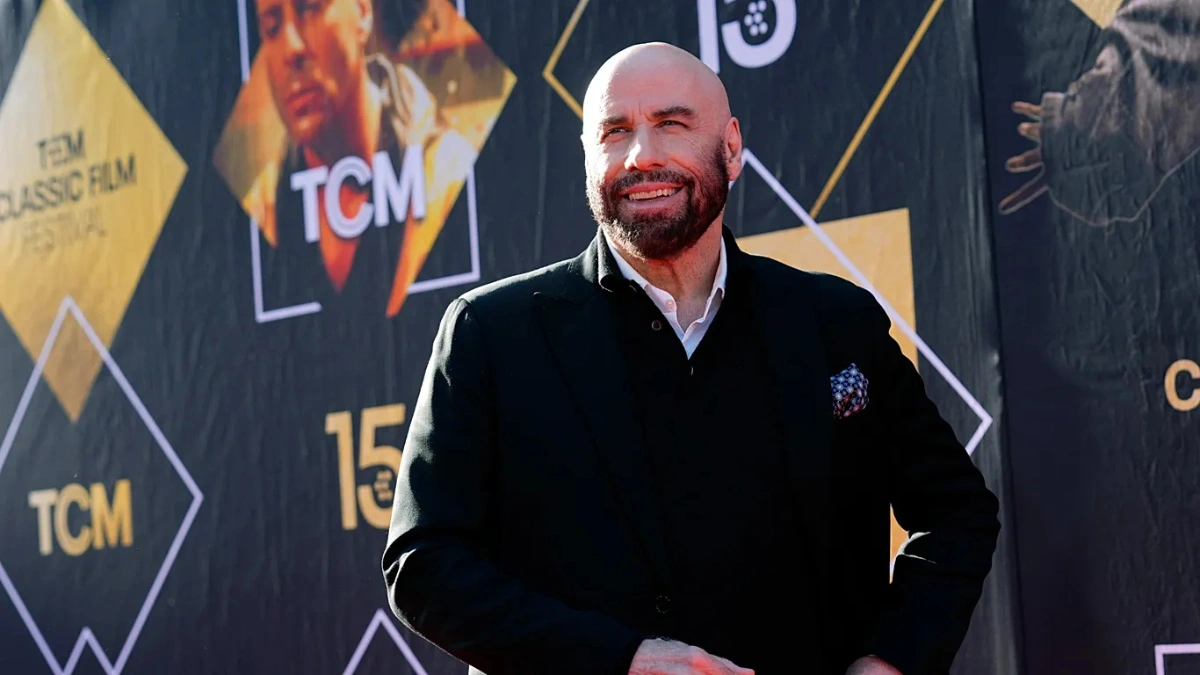
John Travolta
Hollywood legend John Travolta is preparing for one of the biggest moments of his career: the debut of his first film as a director at the Cannes Film Festival. The film, Propeller One-Way Night Coach, is set to premiere in May in the festival’s Cannes Première section, opening a new chapter for the 72-year-old star.
Travolta is not only directing. He also wrote and produced the film, which he has described as the most personal project of his life.
A story born from a love of flying
The film is based on an illustrated children’s book that Travolta wrote in 1997, inspired by his lifelong passion for aviation. A licensed pilot, he has been fascinated by aircraft since childhood, when he would stand in his garden in New Jersey watching planes take off from New York’s LaGuardia airport. Today he has logged around 9,000 flying hours.
Nearly three decades ago, he channelled that love of flight into a book he wrote and illustrated for his son. The story drew on his own early experiences: his first journey on a plane, the people he met and the moments that made him fall in love with the sky. Now that same story is coming to the big screen under his direction.
The story
Set in 1962, Propeller One-Way Night Coach follows a young aviation enthusiast named Jeff, played by newcomer Clark Shotwell. Jeff, who represents a young Travolta, boards a TWA Constellation propeller plane on the East Coast with his mother, played by Kelly Eviston-Quinnett, an actress who may be about to land a role in Hollywood. Their multi-stop flight to Los Angeles turns into an adventure full of unusual encounters.
Audiences are taken on a vivid, imaginative trip through the golden age of air travel: airline meals, glamorous flight attendants, unexpected layovers and colourful fellow passengers. The character of Jeff’s mother is a blend of Travolta’s own mother and sister, the two women he credits with shaping his dreams.
The cast includes Travolta’s daughter, Ella Bleu Travolta, who plays the air hostess Doris, Jeff’s first crush, alongside Olga Hoffmann. The family connection runs through the whole production, and Travolta has said: “My family is the reason I exist as an artist and as a person.”
As the journey unfolds, Jeff’s experiences begin to shape his ambitions, giving the film a gentle coming-of-age feel. With a running time of around an hour, it is designed to appeal to viewers of all ages, mixing nostalgia with a sense of wonder about flying.
A message about hope
Travolta has explained that the film is about more than planes. Looking back at the early 1960s, he described “a romantic time when architecture, aviation, and the automotive industry all offered a lot of hope”. He said that sense of possibility is missing today: “Young people sometimes don’t have much hope, and this film is a gentle reminder of that.”
That optimism is part of what makes the project unusual. In an era of dark, cynical blockbusters, a director choosing to make a warm, family-friendly film about the joy of flying is a quietly bold move.
Five decades on screen
Travolta’s move behind the camera comes after an acting career of more than five decades. He shot to fame in the 1970s with Saturday Night Fever and Grease, which made him one of the biggest stars in the world and earned him his first Oscar nomination.
After a quieter spell in the 1980s, he made one of Hollywood’s great comebacks with Quentin Tarantino’s Pulp Fiction in 1994, earning a second Oscar nomination. He went on to star in hits such as Get Shorty, which won him a Golden Globe, Face/Off and Hairspray, and he showed his range in films such as Brian De Palma’s Blow Out. He also won an Emmy as a producer of the acclaimed series The People v. O.J. Simpson: American Crime Story.
A familiar face at Cannes
Travolta’s connection with Cannes goes back a long way. He has appeared in several films that screened at the festival, including Pulp Fiction, which won the Palme d’Or in 1994, She’s So Lovely and Primary Colors. Returning as a director feels like a fitting full circle.
The festival has a long history of welcoming actors who step behind the camera, and a debut in the Cannes Première section signals that the selection committee sees real value in the work. For more on veteran stars still pushing themselves creatively, read our feature on Al Pacino reflecting on why artists should never stop creating.
Release on Apple TV
After its Cannes debut, Propeller One-Way Night Coach will be released worldwide on Apple TV on 29 May 2026, letting audiences everywhere see Travolta’s first film as a director from home.
Update: a surprise Palme d’Or
The world premiere took place on 15 May in the festival’s Debussy theatre. Before the screening, festival director Thierry Frémaux surprised Travolta with an honorary Palme d’Or. “This is beyond the Oscar,” an emotional Travolta said as he accepted the award, surrounded by his family. “I can’t believe this. This is the last thing I expected,” he added. The honorary award is the festival’s equivalent of a lifetime achievement prize.
The evening was a celebration from start to finish. Travolta was introduced with a ten-minute montage of his film work, set to songs such as “Stayin’ Alive” and “You’re the One That I Want”, and he received several standing ovations before the film even began. Wearing a beret and a neat beard, he looked visibly moved by the reception.
What the critics said
Once the lights went down, the reviews were more divided. Travolta narrates the entire film himself, essentially reading his book aloud over the images, and that choice split critics. Variety called it a “slim and winning” boyhood reverie, praising its sincere nostalgia for the “Mad Men” era of air travel and comparing its storybook tone to A Christmas Story. The Guardian described it as a “charmingly quirky” bedtime story and a “short-haul joyride”, noting its lovingly detailed 1960s production design.
Others were far less kind. The BBC called the film a dud, arguing that the 61-minute running time and non-stop voiceover left little room for real drama, and used it as an example of great actors struggling as directors. Whatever the verdict, few doubted the affection behind it: this is clearly a film Travolta made for his family as much as for the public.
It was a remarkable moment for an actor who has had more ups and downs than most. With this project, Travolta revisits a deeply personal story and shows that his passion for storytelling is still taking off, more than half a century after he first became a star.
About the Author