
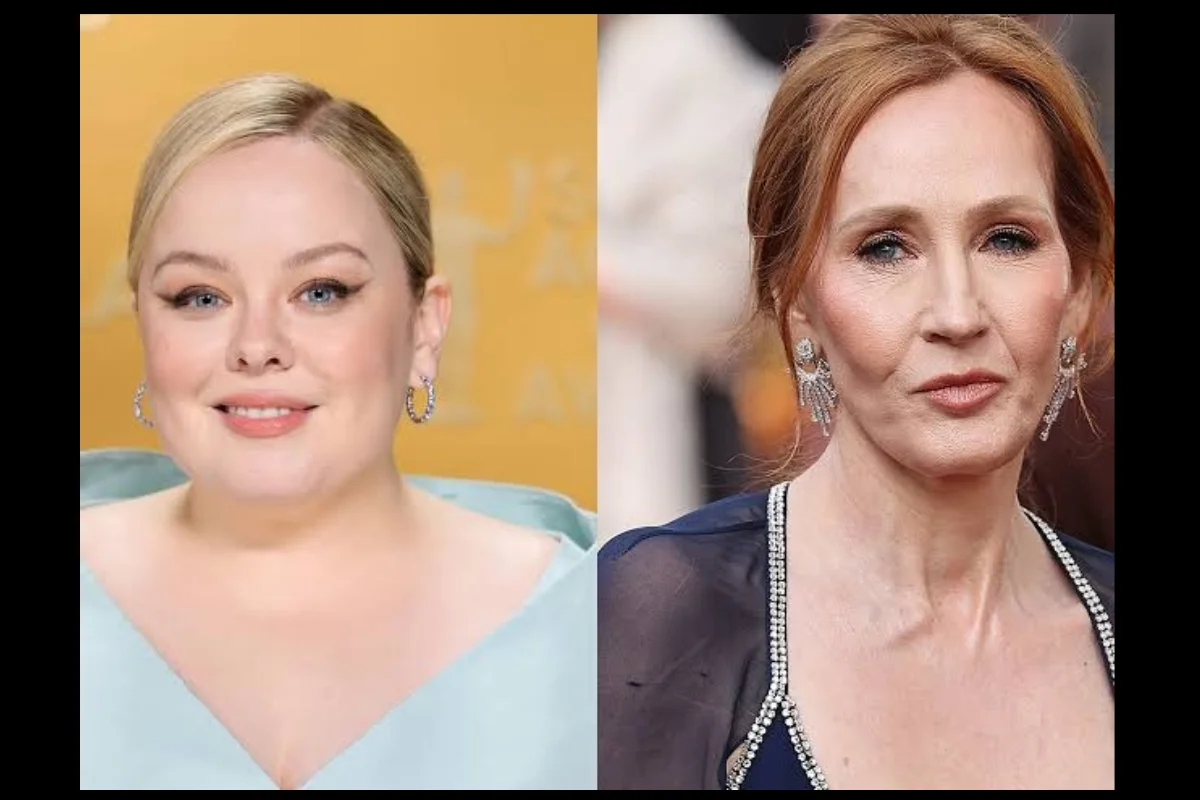
Nicola Coughlan on Harry Potter and J.K. Rowling
The line that sprinted out of Nicola Coughlan’s new Observer interview is short, and it is already the one most people will remember. Asked about HBO’s forthcoming Harry Potter series, the Bridgerton and Derry Girls star said: “I will not be watching the new Harry Potter show and I would never be in it. Look, I know people that are involved in those shows, and they’re nice people and whatever, but it’s not for me.”
Those sentences, given to the Observer over the weekend and picked up across the entertainment press on Monday, harden a position she has held for some time. Coughlan has been publicly at odds with J.K. Rowling over the author’s views on trans rights. The adaptation, on which Rowling is an executive producer, is due to premiere on 25 December, and a new clip circulated only last weekend. The comments landed just as the marketing was gathering speed.
The interview itself is broader than the headline. Over cheesecake in a central London restaurant, she talks about a raw new drama, about fame that arrived in her thirties, and about why she keeps using a public platform even when other famous people tell her they have too much to lose. The Harry Potter refusal sits inside that larger portrait, which is what makes it feel like a consistent stance rather than a stray soundbite.
The clash behind the boycott
Coughlan has not come late to this argument. She loved Rowling’s books as a child growing up near Galway. What she will not do now, she says, is give the new screen version her time or her name.
The most recent public rupture came in 2025, after the UK Supreme Court ruled that the legal definition of a woman is based on biological sex. Rowling posted a photograph of herself with a cigar and a cocktail, writing that she loved it when a plan came together. Coughlan shared a critical article on her Instagram Story and added a line of her own: the new Harry Potter was not something she would “touch with a 10 foot pole.”
Rowling, in response, claimed not to know who Coughlan was, and said the same of Pedro Pascal, who had also criticised her. Coughlan’s retort in the Observer is dry and precise. “Me, I could believe. But Pedro Pascal? You know who Pedro Pascal is, girl. Like, please.”
On the court ruling itself, she was blunter. “To see an already marginalized community being further attacked and attacked in law is really stomach-churning and disgusting, and to see people celebrate it is more stomach-churning.” Those are her words, offered in a newspaper interview, not a legal brief. Rowling has long rejected the accusation that her views are transphobic, and has framed her position as a defence of sex-based rights. Coughlan has chosen, again, to stand on her side of that divide.
The new series has already drawn scrutiny for the people who did say yes. Francesca Gardiner is the showrunner; Mark Mylod is among the directors; the company includes Paapa Essiedu, John Lithgow, Bel Powley and Kit Harington. Lithgow has called Rowling’s views “ironic and somewhat inexplicable.” Coughlan’s position is simpler: she will not watch, and she would never join.
It fits a career in which she has been unusually willing to speak when silence would have been easier, a habit in step with a wider moment this site has been tracing in why so many well-known stars have chosen to come out, and to speak, more openly. Coughlan’s comments are not a coming-out story. They are a decision, made in public, about which rooms she will refuse to enter.
A rawer role, and a habit of speaking up
The professional hook of the Observer interview is I Am Helen, a drama directed by Dominic Savage, whose I Am films have previously been a proving ground for performers including Samantha Morton, Letitia Wright and Kate Winslet. Coughlan calls it her most demanding work. “A lot of the stuff I’ve played before, there’s a lightheartedness to it. And this is very much not. It’s very different and very raw.”
The story is not drawn from her own life. “Thank God I’ve never been in a relationship like that,” she said. She and Savage still wanted a path out of the situation on screen, because, as she put it, the scariest point in an abusive relationship is often the moment of leaving. “You hope that maybe someone will watch this and go, ‘Actually, I don’t need to be in this.’ You can trust your instinct and go, ‘This isn’t right.’”
She reached for an unexpected reference, the old reality series Don’t Tell the Bride, as a cartoon of how little some couples understand one another. In I Am Helen, Steve watches violent pornography and becomes ashamed and defensive when Helen tries to talk about it. “There’s a slippery slope there,” Coughlan said, “where we normalise this misogyny, and it’s just a joke, but where does it end up? Men and women need to have conversations with one another.”
That instinct to say the uncomfortable thing runs through the rest of the conversation. Her late father was a UN peacekeeper, and the family lived for a time in Jerusalem. She is careful not to paint her parents as political operators; she remembers them as people who helped without making a fuss. She has tried, she said, to use her own following in the same spirit, and was disappointed when some better-known peers told her they were not in a strong enough position to speak. “This is bullshit, isn’t it? Everyone has something to lose and everyone has something to gain.” The title of the interview is taken from that line.
The decade that changed the scale, not the person
Coughlan grew up in Oranmore, a town near Galway where, she says, everyone knows everyone. She was already in her early thirties when Derry Girls made her name as Clare. Bridgerton’s third season turned her into a global star. She hosted SNL UK in April, a comic calling card slightly dented when, in dress rehearsal, a sugar-glass bottle she was meant to smash over George Fouracres’s head actually cut his face. “I actually did glass him, it was terrible.”
She will turn 40 in January, a fact she treats as slightly implausible; in her head, she still thinks she is about 30. She is five feet tall and still goes home often. Her boyfriend is the English actor Jake Dunn. Asked about having a family, she refused to pretend she had a plan. “God knows.”
She has no interest, she said, in chasing every blockbuster. She did appear, briefly, as Diplomat Barbie, but going after that scale of fame is “not for me,” a phrase that now rhymes with her verdict on Harry Potter. This summer she filmed a part in Only Murders in the Building and was “gutted” when a scene with Meryl Streep was cut. She still got a hug. She is currently shooting an adaptation of Roald Dahl’s short stories for adults.
Read in full, the Observer interview is not a single-issue broadside. It is a portrait of a performer who became famous late enough to know who she was, and who keeps making the same calculation: that a platform is for using, that instinct is worth trusting, and that some invitations are easier to decline than to justify. The Harry Potter series will arrive on Christmas Day regardless. Coughlan has now said, on the record, that she will not be in the audience, and would never have been in the cast. The more revealing part is how little it seems to have cost her to say it.
About the Author


1 thought on “Nicola Coughlan on Harry Potter and J.K. Rowling: “I Will Not Be Watching… It’s Not for Me””